


When a guest browses your menu, they do not make precise calculations: they scan, compare and feel. By subtly playing on how their brain perceives amounts, you can steer their choices and increase the average ticket.
Studies point to gains of 10 to 50% depending on the context; the good news is that most of the levers lie directly in the presentation, especially if your menu is digital.
10 Price Psychology Tips to Increase Your Sales by 15% Tomorrow
Reading time: ~12 min
1. Understanding price psychology applied to your menu
2. 10 menu price psychology tips to apply from tomorrow
3. Before and after menu example with price psychology
4. Limits, ethics and measuring results
5. Mini FAQ on menu price psychology
Understanding price psychology applied to your menu
Price psychology studies how guests feel, read and compare an amount beyond its simple value. In a restaurant, it depends on the figure displayed, how that figure is written, its position and the other prices around it. On a digital menu, these parameters are even easier to test and adjust thanks to menu engineering and analytics.

Three key ideas to get started
1. The brain reads from left to right: a price of 19.90 looks much lower than 20.
2. Guests look for reference points: a very expensive dish makes the others more attractive (anchoring effect).
3. Guests avoid mental effort: the simpler the price, the more readily it is accepted.
10 menu price psychology tips to apply from tomorrow
1. Use charm prices
A price ending in 9 or 90 exploits the first-digit effect: 19.90 is perceived as much lower than 20. Example before: “Dish of the day 20”. Example after: “Dish of the day 19.90”. On sensitive products (lunch deals, desserts), this simple tweak can gain 10 to 20% in conversions.
2. Create an anchor with a crossed-out price
Display a higher reference price first, then your current price: “Tasting menu (old menu 49) 42”. The offer seems better without devaluing your positioning as long as the display stays temporary.
3. Add a very expensive dish as a high reference
Introducing a premium option (“Prime rib €58”) lifts the perception of dishes at €22-24. Studies show a 20 to 30% rise in sales of mid-priced dishes.
4. Offer three price levels
An “entry-level / target / premium” trio steers most guests toward the middle option. Example: €4 for the house wine, €6.50 for the sommelier’s selection, €9 for the grand cru.
5. Group offers into set menus or packs
Bundling (“Starter + Main”, “Main + Dessert”, “Board + Drink”) makes the whole look like good value compared with separate prices and can boost some categories by up to 50%.
6. Use a leader price
A very competitive hook product (a glass of house wine, a small board) attracts guests, then raises the ticket when they add other, more profitable choices.

7. Subtly compare with more expensive options
Placing a €22 dish between €15 and €26 makes it look reasonable. Reorganise your sections and check the clicks in your analytics.
8. Break up the price columns
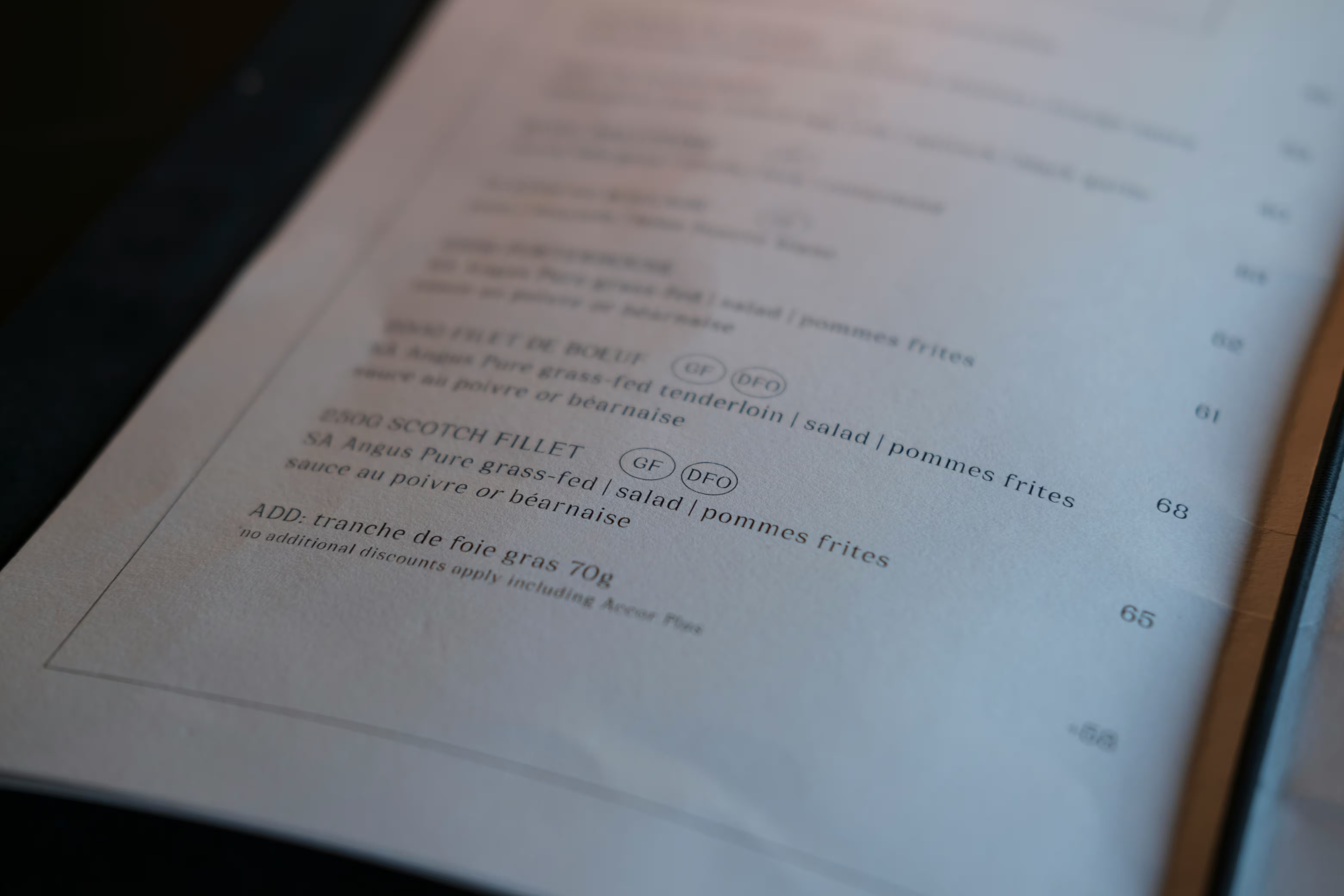
By building the amount into the end of the description (“Homemade burger, brioche bun… 18”), you prevent cold spreadsheet-style comparison and focus on the culinary experience.
9. Present from most to least expensive
Start each section with the most premium offers; after seeing €28, a €22 dish looks affordable. Test the reverse order over a period and measure the effect.
10. Play on urgency and simple discounts
Promotions work better when they are limited and easy to understand: “Chef’s week: full menu €28 instead of €32, limited quantity each evening”.
Before and after menu example with price psychology
Before version
• Price display: right-aligned column • Main courses: sorted from cheapest to most expensive • Premium offer: none • Set menus: no lunch deal
Optimised after version
• Prices built into the description • Dishes sorted from most to least expensive • Prime rib for sharing added at the top of the section • “Main + Dessert” deal with a charm price
Once the new structure is published on a QR code menu, track views, the average ticket and the progress of set menus to adjust continuously.
Limits, ethics and measuring results
These techniques never make up for a disappointing plate; they simply align perception with real value. Do not overuse promotions so as not to frustrate regulars, and always test one to three tips at a time while analysing your data (views, conversions, average ticket, tourist segmentation, etc.).
Mini FAQ on menu price psychology
Is it really useful to change only the presentation? Yes, formatting influences the decision even at an identical amount.
Should I remove the euro sign entirely? It is only a detail. The main goal is to reduce mental load; a clear, discreet price is enough.
Should these techniques be applied everywhere? Concentrate them on your best-sellers, your high-margin dishes and your key set menus.
Is a paper menu enough? You can already act on paper, but digital lets you test, measure and adjust without reprinting.
To go further: Menu engineering with AI for restaurants and the Appero blog.